Our Skies
The universe may in theory be relatively empty of matter, but there is
still much to wonder at. Telescopes such as the Hubble Space Telescope
have been sending back computerised images which give us visual clues as
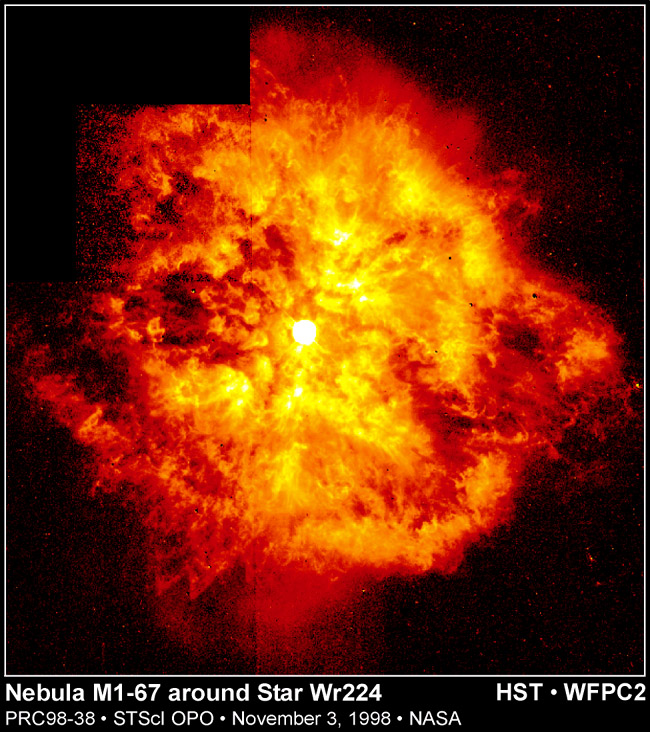
to what is happening in our skies. Here we see one such image of activity
in a distant star.
Click one of the links to find out more about our nearby planets.
Mercury Venus Earth Mars
Jupiter Saturn Uranus Neptune Pluto
Great Balls of Fire!
Resembling an aerial fireworks explosion,
this dramatic NASA Hubble Space Telescope picture of the energetic star
WR124 reveals it is surrounded by hot clumps of gas being ejected into
space at speeds of over 100,000 miles per hour. Also remarkable are vast
arcs of glowing gas around the star, which are resolved into filamentary,
chaotic substructures, yet with no overall global shell structure. Though
the existence of clumps in the winds of hot stars has been deduced through
spectroscopic observations of their inner winds, Hubble resolves them directly
in the nebula M1-67 around WR124 as 100 billion-mile wide glowing gas blobs.
Credit:
NASA|
The
Space
Telescope Science Institute is operated by the Association
of Universities for Research in Astronomy, Inc. (AURA), for NASA,
under contract with the Goddard
Space Flight Center, Greenbelt, MD. The Hubble Space Telescope is a
project of international cooperation between NASA and the
European Space Agency (ESA).
Copyright©
1998 The Association of Universities for Research in Astronomy, Inc. All
Rights Reserved.